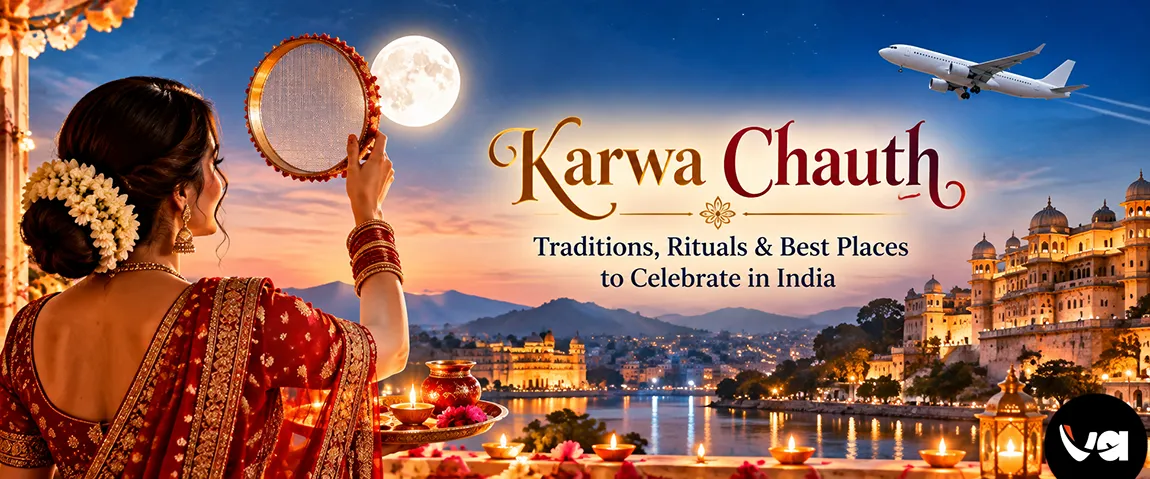
Karwa Chauth 2026: Traditions, Rituals & Best Places To Celebrate In India
Posted on Friday, October 9th, 2026 by Neha Sharma Leave a Comment
Sargi before sunrise, a day of fasting, an evening puja with family, and the wait for the moon- these are some of the moments that shape Karwa Chauth. In 2026, Karwa Chauth will be observed on Thursday, October 29, with the main rituals taking place throughout the day and evening.
For many families, the festival is also a time to come together. Married couples may return to their hometowns, newly married women may celebrate their first Karwa Chauth with family, and others may travel to places where the customs have a strong regional presence. Punjab, Delhi, Uttar Pradesh, Haryana and Rajasthan are among the regions where Karwa Chauth is particularly established.
If you are planning a Karwa Chauth trip in 2026, knowing the traditions as well as the practical travel details can help you plan the day without rushing from the airport to the evening rituals.
When Is Karwa Chauth 2026?
Karwa Chauth 2026 will be observed on Thursday, October 29, 2026. The festival falls on Krishna Paksha Chaturthi and is also known as Karaka Chaturthi.
| Karwa Chauth 2026 Information | Details |
| Date | Thursday, October 29, 2026 |
| Lunar Day | Krishna Paksha Chaturthi |
| Fast | Traditionally observed from sunrise until moonrise |
| Main evening ritual | Moon sighting and Arghya |
| Moonrise | Varies by city |
The exact puja and moonrise timings depend on the location. For example, the New Delhi panchang lists a puja muhurat of approximately 5:38 PM to 6:56 PM and moonrise at about 8:17 PM on October 29. Jaipur’s calculated moonrise is later, around 8:28 PM according to Drik Panchang. These differences are why travellers should check the timing for their actual destination rather than relying on one city’s schedule.
What Is Karwa Chauth?
Karwa Chauth is a traditional Hindu festival particularly associated with married women in northern and north-western India. Traditionally, women observe a fast and pray for the well-being and longevity of their husbands. The festival is also associated with the marital bond and family relationships.
The word karwa refers to the earthen pot used during the rituals, while chauth refers to the fourth lunar day. During the puja, the karwa has an important role in the traditional offering of water to the Moon.
The observance is not identical in every household. In some families, husbands also participate in the fast, while some unmarried women observe a version of the vrat. Customs can also change from one region to another.
Lord Shiva, Goddess Parvati and Lord Ganesha are traditionally associated with the worship, while the Moon becomes central to the evening ritual.
Why Is Karwa Chauth Celebrated?
The traditional significance of Karwa Chauth centers on marital devotion, prayers for a spouse’s well-being and family bonds.
For women observing the vrat, the fast traditionally continues from sunrise until the Moon is sighted. The evening ritual then brings together the fast, puja, Moon offering and breaking of the fast.
It is important to describe this as a religious and cultural tradition rather than a guarantee of a particular outcome. Traditionally, the fast is observed as a prayer for the husband’s long life and well-being; it should not be presented as something that medically or supernaturally guarantees either.
For many families today, Karwa Chauth is also about spending time together, preparing festive food, dressing up, meeting relatives and maintaining customs that have been passed down through generations.
Karwa Chauth 2026 Rituals And Traditions
The day’s rituals follow a familiar pattern, although individual practices differ between families and regions.
- Sargi Before Sunrise
Sargi is the traditional pre-dawn meal associated with Karwa Chauth. It is commonly prepared or given by the mother-in-law for her daughter-in-law, although arrangements vary when families live separately.
The meal may include fruits, dry fruits, sweets, chapatis, vegetables, milk-based dishes & other foods chosen by the family. In Uttar Pradesh, Incredible India describes regional Sargi preparations that can include feni, sweets and savouries, coconut, dry fruits and fara.
The important point is that Sargi is not a fixed menu followed identically everywhere. Families often adapt it according to local customs and personal preferences.
- Karwa Chauth Puja
The evening puja is one of the central parts of the festival. Women prepare their puja thalis with items used according to their family tradition, along with the karwa or pot.
In many communities, women gather together, listen to the Vrat Katha, exchange or rotate thalis and offer prayers. The presence of older women in the family is particularly important in some traditions because they guide younger women through the rituals.
The exact puja procedure can vary, so travellers celebrating away from home may want to check with their family or local community about the customs they follow.
- Mehendi, Bangles and Festive Preparation
Karwa Chauth also has a strong festive-preparation side. Women may apply mehendi, wear traditional clothes, choose bangles and jewellery & prepare their thalis before the evening ceremony.
In Uttar Pradesh, mehendi, traditional clothing, jewellery & gifts are documented as part of regional Karwa Chauth customs.
For newly married women, the first Karwa Chauth can be particularly significant, with families often making additional arrangements around clothing, gifts and the gathering.
Moon Sighting and Breaking the Fast
The evening reaches its main moment when the Moon becomes visible.
A commonly followed sequence is:
Moon appears → Moon is viewed through a sieve → Arghya is offered → husband participates in the ritual → fast is broken
In Punjab, Incredible India describes women viewing the Moon through a sieve and offering water before receiving water and sweets from their husbands to break the fast.
Not every family follows precisely the same sequence. Some use different items, prayers, or methods of performing the Moon ritual.
| Ritual | When It Happens | What It Involves |
| Sargi | Before sunrise | Traditional pre-fast meal |
| Vrat | Daytime | Fasting |
| Puja | Evening | Karwa Chauth worship |
| Vrat Katha | During puja | Traditional story |
| Moon sighting | Night | Moon viewing and Arghya |
| Breaking the fast | After moonrise | Traditional completion of vrat |
Karwa Chauth Story And Traditional Beliefs
One popular Karwa Chauth legend tells the story of Veervati, a woman who was the only sister among seven brothers.
According to the traditional story, Veervati observed the fast but became weak while waiting for the Moon. Her brothers, worried about her condition, created a false impression that the Moon had risen. Believing that she had seen the Moon, Veervati broke her fast. The story then takes a tragic turn before her devotion and penance eventually lead to her husband’s restoration.
This is a traditional religious legend, not a historical account. Different communities may tell the story with variations, and other stories are also associated with Karwa Chauth. Incredible India, for example, also mentions the traditional association with Savitri and Satyavan.
The story is generally included as part of the Vrat Katha rather than being the sole explanation for the festival.
How Karwa Chauth Is Celebrated In Different Parts Of India
Karwa Chauth has a strong presence in northern India, but the details change according to local culture and family practice. Punjab, Haryana, Uttar Pradesh, Rajasthan, and Delhi are among the regions where the festival has a particularly visible presence.
Karwa Chauth In Punjab
Punjab has some of the most clearly documented Karwa Chauth customs. The day traditionally begins with Sargi before sunrise, while the evening includes group gatherings, thalis, the Vrat Katha and the Moon ritual.
In Punjab, the Bayaa sent from the woman’s maternal family can include clothing, coconut, sweets, fruits and sindoor. Sargi may contain fruits, dry fruits, sweets, chapatis and vegetables.
The evening Moon ritual is often followed by a family meal. Traditional foods mentioned by Incredible India include sabut dal, pooris, rice and sweets.
- Chandigarh to Amritsar Flights
- Hyderabad To Amritsar Flights
- Kolkata To Amritsar Flights
- Bangalore To Amritsar Flights
- Pune To Amritsar Flights
Karwa Chauth In Delhi
Delhi has a strong Karwa Chauth presence, partly because of its long-standing Punjabi and North Indian cultural influences. Drik Panchang notes the significance of Karwa Chauth in Delhi and the NCR, where many Punjabi families follow the tradition.
The city also offers a distinctly urban version of the festival, with families organising home pujas, neighbourhood gatherings, festive shopping and mehendi appointments before the evening ritual.
- Mumbai to Delhi Flights
- Kolkata to Delhi Flights
- Pune To Delhi Flights
- Bangalore To Delhi Flights
- Ahmedabad To Delhi Flights
- Hyderabad To Delhi Flights
Karwa Chauth In Uttar Pradesh
Karwa Chauth in Uttar Pradesh has its own regional details. Sargi can include feni, sweets, savouries, coconut, dry fruits and fara, while traditional gifts may include clothing and jewellery. Mehendi and evening gatherings are also part of the observance in many communities.
Some areas have additional local practices around the Moon, karvas and the evening prayers. This makes Uttar Pradesh particularly interesting for families who want to celebrate the festival within a regional setting.
Flights Uttar Pradesh Routes
- Mumbai To Agra Flights
- Hyderabad to Agra Flights
- Bangalore To Agra Flights
- Mumbai to Varanasi Flights
- Pune to Varanasi Flights
- Ahmedabad to Varanasi Flights
- Bangalore to Varanasi Flights
- Delhi To Lucknow Flights
- Amritsar To Lucknow Flights
- Bangalore To Lucknow Flights
- Ahmedabad To Kanpur Flights
- Ahmedabad To Ayodhya Flights
- Bangalore To Ayodhya Flights
Karwa Chauth In Rajasthan
Rajasthan is also among the northern states where Karwa Chauth is traditionally observed.
In Jaipur, families may combine the vrat and puja with traditional clothing, mehendi, jewellery, family gatherings and festive food. The exact customs depend on the family and community, so visitors should treat the experience as a local family celebration rather than a single city-wide event.
Flights to Rajasthan Routes
- Chandigarh To Jaipur Flights
- Delhi To Jaipur Flights
- Dehradun To Jaipur Flights
- Jammu To Jaipur Flights
- Mumbai To Jaipur Flights
- Chandigarh To Udaipur Flights
- Delhi To Udaipur Flights
- Mumbai To Udaipur Flights
- Ahmedabad To Udaipur Flights
- Jaipur To Udaipur Flights
- Nagpur to Udaipur Flights
Best Places To Experience Karwa Chauth In India
There is no single destination that can objectively be called the “best” place for Karwa Chauth. The experience depends largely on where families and communities are observing the festival.
For travellers looking for destinations with documented or established Karwa Chauth traditions, these five cities offer practical options.
1. Chandigarh
Chandigarh sits at an interesting cultural point between Punjab and Haryana, making it a natural choice for travellers interested in North Indian Karwa Chauth customs.
Families may observe Sargi, dress traditionally, apply mehendi, organise group pujas and gather for the Moon-sighting ritual. If you are travelling from Delhi to spend the festival with relatives in Chandigarh, you can compare Delhi to Chandigarh flights on Travanya. The route page currently lists Delhi’s DEL airport and Chandigarh’s IXC airport.
2. Amritsar
Amritsar is a useful choice for travellers who want to experience Karwa Chauth within a strongly Punjabi cultural setting. Sargi, festive clothing, mehendi, family gatherings and the evening Moon ritual form part of the wider Punjabi observance documented by Incredible India.
If your wider itinerary includes travelling onward from Amritsar to the capital, Travanya’s Amritsar to Delhi flights page provides the relevant domestic route. The page currently identifies ATQ as Amritsar and DEL as Delhi.
3. Delhi
Delhi works well for people who want to combine family celebrations with the convenience of a major metropolitan city.
Karwa Chauth gatherings can take place within residential communities, family homes and neighbourhood groups. Festive shopping, mehendi and traditional clothing are also easy to incorporate into the days leading up to the festival.
For families travelling from Maharashtra to spend Karwa Chauth with relatives in Delhi, Mumbai to Delhi flights are one domestic option to compare. Travanya’s current route page identifies BOM as Mumbai and DEL as Delhi.
4. Lucknow
Lucknow offers a practical base for experiencing Karwa Chauth traditions in Uttar Pradesh. The regional customs documented by Incredible India include Sargi, mehendi, traditional clothing, jewellery, evening prayers and Moon-related rituals.
Travellers coming from Delhi can check Delhi to Lucknow flights when planning their journey. Travanya currently maintains a dedicated DEL–LKO route page.
5. Jaipur
Jaipur brings Rajasthan’s traditional festive setting into the Karwa Chauth travel plan. The city is among the northern Indian locations where Karwa Chauth is traditionally observed.
For visitors, the experience may include family pujas, traditional clothing, mehendi and Moon-sighting rituals rather than a single central public celebration. Jaipur’s Karwa Chauth moonrise is also different from Delhi’s; Drik Panchang currently calculates it at around 8:28 PM on October 29, reinforcing the need to check destination-specific timings.
Travellers coming from the capital can compare Delhi to Jaipur flights on Travanya when arranging their trip.
Karwa Chauth Fasting and Travel
Travelling on a fasting day requires some practical planning, particularly for people following the traditional sunrise-to-moonrise observance.
Try to keep the journey comfortable and avoid unnecessarily complicated itineraries. If you have a connecting flight, allow enough time at the airport rather than choosing an extremely tight connection simply to shorten the total journey.
If your personal fasting practice permits you to carry particular foods or drinks, check the airline’s current rules before travelling. Airport security and airline policies can apply to food and liquids.
Families travelling together should also coordinate airport transfers in advance. This is especially useful when one member is observing the vrat and the rest of the family is managing luggage, children or local transport.
Most importantly, remember that the evening ritual depends on local Moonrise, not the time shown for another city. A traveller leaving Delhi for Jaipur, for example, should use Jaipur’s local timing for the Moon ritual.
Conclusion
Karwa Chauth 2026 falls on Thursday, October 29, but the way the festival is experienced depends on the family and region. Sargi, the vrat, evening puja, mehendi, the Vrat Katha and Moon sighting create a familiar framework, while Punjab, Uttar Pradesh, Delhi, Haryana and Rajasthan each bring their own customs to the day.
For families travelling to celebrate together, the festival can also become a reason to return home or spend a few days in another city. If you are planning a Karwa Chauth trip, compare suitable domestic flight options on Travanya, check the local Moonrise timing and leave enough time for the evening rituals.
FAQs
When is Karwa Chauth in 2026?
A: Karwa Chauth will be observed on Thursday, October 29, 2026. It falls on Krishna Paksha Chaturthi and is also known as Karaka Chaturthi.
What is the significance of Karwa Chauth?
A: Traditionally, Karwa Chauth is observed as a day of fasting and prayer for the well-being and longevity of the husband. It also has a broader role in family and marital traditions, with customs varying between regions and households.
What time does the Karwa Chauth fast begin and end?
A: The traditional fast begins after the pre-dawn meal and continues through the day until the Moon is sighted. Exact timings depend on the local sunrise and Moonrise. For New Delhi in 2026, Drik Panchang lists the upavasa period from about 6:31 AM to 8:17 PM.
What is Sargi on Karwa Chauth?
A: Sargi is the traditional pre-sunrise meal eaten before the fast. It is commonly associated with the mother-in-law giving the meal to her daughter-in-law, although the practice varies between families. Foods can include fruits, dry fruits, sweets and regional dishes.
What are the main Karwa Chauth rituals?
A: The main rituals include Sargi before sunrise, daytime fasting, evening puja, the Vrat Katha and the Moon-sighting ceremony. The fast is traditionally completed after the Moon is sighted and the customary offering is made.
Why do women look at the Moon through a sieve?
A: Viewing the Moon through a sieve is a widely followed Karwa Chauth custom, particularly in northern India. The sieve forms part of the evening ritual before the woman performs the Moon offering and breaks her fast.
Which places in India are known for Karwa Chauth celebrations?
A: Punjab, Haryana, Uttar Pradesh, Rajasthan and Delhi are among the regions where Karwa Chauth has a strong traditional presence. Chandigarh, Amritsar, Delhi, Lucknow and Jaipur can therefore be useful destinations for travellers interested in regional celebrations.
How is Karwa Chauth celebrated in Punjab?
A: Punjab’s observance includes Sargi, festive clothing, family gifts, group gatherings, thali rituals, the Vrat Katha and Moon-sighting ceremony. The evening meal may include dishes such as sabut dal, pooris, rice and sweets.
How is Karwa Chauth celebrated in Uttar Pradesh?
A: In Uttar Pradesh, Sargi can include feni, sweets, savouries, coconut, dry fruits and fara. Women may also wear traditional clothing, jewellery and mehendi before joining evening prayers and Moon-related rituals. Customs differ across communities.
Can I travel by domestic flight on Karwa Chauth?
A: Yes, people can travel by domestic flight on Karwa Chauth, but anyone planning to observe the fast and evening rituals should leave enough time for airport transfers and delays. Check your destination’s Moonrise time rather than relying on the timing for another city.

About Neha Sharma View All Posts
Neha Sharma, a passionate travel blogger, captures the beauty of the world through her words. With her adventurous spirit and a keen eye for detail, Neha takes her readers on mesmerizing journeys to exotic destinations. Her vivid descriptions and insightful tips make her the go-to guide for wanderlust seekers. Join Neha as she explores the globe, sharing her love for travel and inspiring others to go on their unforgettable adventures.
Latest Blog
-
10 Different Ways Of Celebrating Dussehra Across Indian States
Oct 1st, 2026 -
Sharad Navratri 2026 Dates, Significance, Celebrations And Travel
Sep 24th, 2026 -
Ganesh Chaturthi 2026: Best Places to Celebrate in India
Sep 17th, 2026 -
25 Best Destinations to Celebrate Christmas Around the World
Oct 14th, 2026 -
Air India Launches Easy Connect Flights From Ahmedabad To 26 Global Destinations
Sep 4th, 2026 -
20 Famous Places to Visit in Kerala in 2026 for a Memorable Holiday
Aug 31st, 2026



Leave a Comment