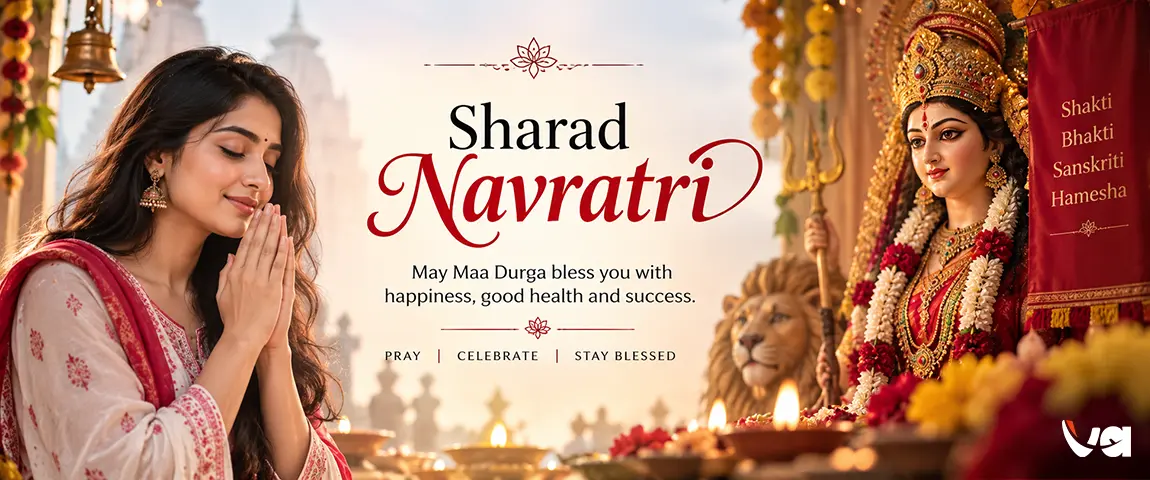
Sharad Navratri 2026 Dates, Significance, Celebrations And Travel
Posted on Thursday, September 24th, 2026 by Neha Sharma Leave a Comment
Sharad Navratri is another prominent festival of Hindu culture, which is celebrated over nine days in worship of Goddess Durga and her nine forms. In the year 2026, Sharad Navratri will commence on Sunday, October 11 and will mark it’s end on Monday, October 19 while Vijayadashami or Dussehra will observed on Tuesday, October 20.
The festival takes other forms in different states of India. The Gujarati’s revel in Garba and Dandiya, New Delhi and many states of North India celebrate Ramleela and Dussehra, the Bengalis observe Durga Puja, Mysureans celebrate Dasara. Several families go back to their hometowns, visit relatives or explore other cities to participate in the festival.
What Is Sharad Navratri?
Sharad Navratri, also called Shardiya Navratri, is a nine-night Hindu festival associated with the worship of Goddess Durga and Shakti. It falls during the Sharad season and is observed in the Hindu month of Ashwin. The name Shardiya is linked with the Sharad season.
The festival lasts for nine nights and ten days, with each day traditionally associated with one of the nine forms of Goddess Durga, known as Navdurga. The ninth day is followed by Vijayadashami on the tenth day.
Different communities follow their own customs during Sharad Navratri. Prayer, fasting, temple visits, Durga Puja, Garba, Dandiya and other local traditions form part of the celebrations.
When Is Sharad Navratri 2026?
Sharad Navratri 2026 begins on October 11, 2026, and the nine-day observance continues until October 19, 2026. Vijayadashami or Dussehra falls on October 20, 2026. The 2026 Panchang calendar confirms October 11 as the first day and October 20 as Vijayadashami.
| Event | Date |
| Sharad Navratri begins | October 11, 2026 |
| Navratri celebrations | October 11–19, 2026 |
| Vijayadashami / Dussehra | October 20, 2026 |
Exact puja and Ghatasthapana timings can vary by location, so travellers and devotees should check a local Panchang before planning a specific ritual.
Why Is Sharad Navratri Celebrated?
Sharad Navratri is a festival, which is of religious and cultural significance for the followers of Goddess Durga. As per the mythological information, the festival is observed to worship the various aspects of Shakti the Goddess.
Over the years, many stories have emerged through oral tradition about Goddess Durga fighting Mahaishasura, with the most well-known story depicted in these images. These stories are sometimes interpreted as the victory of good over evil through the story of Goddess Durga. Mahaishasura reaches the concluding highpoint on the festival of Vijaya-dhashami, according to which region of India the celebrations accompany either the victorious goddess or Lord Rama defeating Ravana.
The specific traditions and folklore related to the festival vary among different communities. To countless devotees, these nine days serve as a time for prayer and reflection. ation and fasting.
Nine Forms Of Goddess Durga During Navratri
The nine days of Navratri are traditionally associated with nine forms of Goddess Durga. These forms are collectively known as Navdurga.
| Navratri Day | Goddess | Traditional association |
| Day 1 | Shailputri | Worshipped on the first day of Navratri |
| Day 2 | Brahmacharini | Associated with devotion and spiritual discipline |
| Day 3 | Chandraghanta | Traditionally represented with a crescent moon |
| Day 4 | Kushmanda | One of the nine forms worshipped during Navratri |
| Day 5 | Skandamata | Traditionally associated with Lord Skanda |
| Day 6 | Katyayani | A form of Goddess Durga worshipped on the sixth day |
| Day 7 | Kalaratri | Traditionally associated with protection and the removal of darkness |
| Day 8 | Mahagauri | Traditionally associated with purity |
| Day 9 | Siddhidatri | The ninth form of Navdurga |
These descriptions represent traditional religious associations and should not be treated as guarantees of specific outcomes.
How Is Sharad Navratri Celebrated In India?
The Navratri celebration in India varies from one region to another. Families and communities may follow different rituals, foods, music, clothing and forms of worship.
- Gujarat
Gujarat is closely associated with Garba and Dandiya during Navratri. Community grounds and venues host evening events where people gather for traditional dances. Many participants wear traditional Gujarati outfits and attend Garba or Dandiya events with family and friends.
Ahmedabad and Vadodara are among the cities where travellers can find large-scale Navratri events.
- West Bengal
In West Bengal, Navratri overlaps with the major Durga Puja period. Kolkata is particularly known for Durga Puja pandals, artistic installations, cultural programmes and traditional rituals.
Dhunuchi dance and Sindoor Khela are also associated with Durga Puja in communities where these customs are traditionally observed.
- Maharashtra
Maharashtra observes Navratri through Devi worship, Ghatasthapana & community celebrations. Many families maintain their own household traditions, while cities such as Mumbai also host public festive events.
- Delhi and North India
In Delhi and several parts of North India, Navratri is associated with Mata ki Chowki, Jagran, temple visits and Ramleela performances. Dussehra celebrations on the tenth day are also an important part of the festive period.
- Karnataka and South India
South Indian Navratri traditions vary by state and community. Golu or Bommai Kolu is observed in parts of South India, while Mysuru is particularly known for its Dasara traditions.
Travellers should keep in mind that celebrations can vary even within the same state, so local event schedules are useful when planning a visit.
Sharad Navratri Traditions And Rituals
Common Navratri traditions include:
- Ghatasthapana and Kalash installation
- Daily prayers and Devi worship
- Visiting temples
- Durga Puja
- Fasting
- Kanya Pujan or Kanjak in communities where it is observed
- Garba and Dandiya
- Home and community decorations
- Religious gatherings and cultural programs
There is no single set of customs followed by every family. Fasting rules, puja methods & the days on which specific rituals are performed can differ by region and family tradition.
Navratri Fasting And Food Traditions
Navratri fasting is common among many devotees, but the rules followed during a fast are not the same for everyone.
Depending on family and regional traditions, people may eat foods such as:
- Fruits
- Sabudana
- Kuttu flour
- Singhara flour
- Samak rice
- Dairy products
- Nuts
- Certain vegetables
- Sendha namak
Some people observe a complete fast, while others follow a restricted diet during the nine days. Anyone fasting should follow their own religious or family practice and consider their individual dietary needs. Navratri fasting should not be presented as a medical treatment or as a guaranteed health practice.
Navratri Colours 2026
The Navratri colour sequence changes each year according to the weekday on which the festival begins. For 2026, the nine colours listed by Drik Panchang are Orange, White, Red, Royal Blue, Yellow, Green, Grey, Purple and Peacock Green.
| Day | Date | Navratri Color |
| Day 1 | October 11 | Orange |
| Day 2 | October 12 | White |
| Day 3 | October 13 | Red |
| Day 4 | October 14 | Royal Blue |
| Day 5 | October 15 | Yellow |
| Day 6 | October 16 | Green |
| Day 7 | October 17 | Grey |
| Day 8 | October 18 | Purple |
| Day 9 | October 19 | Peacock Green |
Wearing the designated colour is a popular Navratri custom, particularly in Gujarat and Maharashtra, although it is not a universal practice.
Best Places In India To Experience Sharad Navratri
If you want to combine Navratri travel in India with festive experiences, several cities have traditions that may interest you.
| Destination | Popular Celebration | What Travellers Can Experience |
| Ahmedabad | Garba and Dandiya | Large community dance events and traditional celebrations |
| Vadodara | Garba | Community Garba events and festive gatherings |
| Mumbai | Devi worship and Garba | Community events, temple visits and festive programmes |
| Kolkata | Durga Puja | Durga Puja pandals, cultural programmes and traditional rituals |
| Delhi | Ramleela and Dussehra | Ramleela performances, temple events and Dussehra celebrations |
| Mysuru | Dasara | Dasara-related cultural events and local traditions |
| Jaipur | Navratri and Dussehra events | Local festive programmes and religious celebrations |
| Chandigarh | Navratri events | Community celebrations and religious gatherings |
| Varanasi | Navratri and religious events | Temple visits and traditional celebrations |
The nature and schedule of public events can change from year to year. Check local event information before booking your trip.
Travelling During Sharad Navratri
Navratri can be a meaningful time to travel for people visiting family, returning to their hometowns or attending celebrations in another city.
If you are planning festive travel, consider:
- Finalizing your dates of travel earlier.
- Compare the departure dates next door if they fit into your schedule.
- Investigate local immediate airports.
- Checking baggage allowances before booking.
- Also, check the cancellation and change terms.
- Give yourself extra time at the airport.
- Verify your flight schedule before heading to the airport.
- Prepare your identity and travel passes.
The flight fares and availability may differ as per demand, date of travel, route of travel, and time of booking. It cannot be said in general that the fare will increase for each and every route during Navratri.
Domestic Flights For Navratri Travel
Travellers planning to attend Garba in Ahmedabad, visit family in another city or return home for the festive period can compare available domestic flight options according to their dates.
For example, routes such as Delhi to Ahmedabad, Mumbai to Ahmedabad, Delhi to Mumbai, Mumbai to Vadodara, Delhi to Jaipur, Bangalore to Delhi and Chennai to Mumbai may be relevant for different travel plans. Actual schedules & availability should be checked for the intended date before booking.
Travanya provides domestic flight booking options across India, making it possible to search available flight choices for your planned journey.
International Travel Around The Navratri Season
Some travellers may plan an international holiday before or after their visit to India for Navratri. For example, a person returning to India for family celebrations may also plan a short trip to Dubai, Singapore, London, Toronto, New York, or Bangkok.
Travanya also provides international flight booking options from India, so travellers can check available international flights along with their domestic travel plans.
International flight schedules, fares and availability depend on the travel date and route, so check the latest options before making a booking.
Tips For Booking Flights During Sharad Navratri
A few simple steps can make festive flight planning easier:
- Get your dates set in the beginning: this is particularly helpful if you have other commitments, such as family commitments or events.
- Experiment with dates: Adjusting one or both your departure or arrival dates by a day can expand options.
- What to think about your airports: if it is reasonable, please try a different airport.
- Select rate type: Select whether to change to one-way or round-trip.
- Baggage allowances for checked baggage: the airline’s baggage policy differs according to the fare and route.
- Allow cancellation time: Read the fare conditions before payment.
- Verify airport info: make sure it is the right airport by checking the departure terminal and other information.
- Allow more airport time: extra time in busy seasons.
- Check ahead on your flight status: Timetables change.
- Have documents prepared: make sure you bring your identity and travel documents.
Travanya also has a flight status tracker that allows travellers to check flight information by flight, route, or airport.
Sharad Navratri And Dussehra Connection
Sharad Navratri is observed over nine nights, from October 11 to October 19 in 2026. The tenth day, October 20, is Vijayadashami or Dussehra.
Navami marks the ninth day of Navratri. Vijayadashami follows it and is observed through different traditions across India. In many communities, the day is associated with the victory of good over evil. The specific way Dussehra is observed differs by region.
In North India, Ramleela and the burning of effigies of Ravana are common Dussehra traditions. In other parts of India, Vijayadashami may be connected more closely with Goddess Durga, local Dasara traditions or other regional customs.
Plan Your Sharad Navratri Travel TODAY!
Sharad Navratri brings together religious observances, family visits and regional celebrations across India. If you are planning to visit family, attend Navratri events in another city, or add a trip around the festive season, check available domestic or international flight options with Travanya and plan your journey around your dates.
FAQs
Q.When is Sharad Navratri 2026?
A: Sharad Navratri 2026 begins on Sunday, October 11 and the nine-day observance continues until October 19. Vijayadashami or Dussehra will be observed on Tuesday, October 20, 2026.
Q.How many days is Sharad Navratri?
A: Sharad Navratri is observed for nine nights and ten days. The first nine days are associated with the worship of the nine forms of Goddess Durga, while the tenth day is Vijayadashami or Dussehra.
Q.What is the significance of Sharad Navratri?
A: Sharad Navratri is traditionally dedicated to Goddess Durga and the nine forms of Shakti. According to Hindu tradition, the festival is also associated with the victory of good over evil. Families may observe the period through prayers, fasting, temple visits and other regional customs.
Q.What are the nine forms of Goddess Durga?
A: The nine forms are Shailputri, Brahmacharini, Chandraghanta, Kushmanda, Skandamata, Katyayani, Kalaratri, Mahagauri and Siddhidatri. Each form is traditionally associated with one of the nine days of Navratri.
Q.How is Sharad Navratri celebrated in India?
A: Celebrations differ across India. Gujarat is known for Garba and Dandiya, West Bengal for Durga Puja, Delhi and parts of North India for Ramleela and Dussehra events, while Mysuru has its own Dasara traditions. Families also follow their own prayer, fasting and food customs.
Q.Which cities are famous for Navratri celebrations?
A: Ahmedabad, Vadodara, Mumbai, Kolkata, Delhi and Mysuru are among the Indian cities known for major Navratri, Durga Puja or Dasara-related celebrations. The type of celebration differs from city to city.
Q.What is the difference between Sharad Navratri and Chaitra Navratri?
A: Both are nine-day Hindu festivals associated with the worship of Goddess Durga and her forms, but they occur at different times of the Hindu calendar. Sharad Navratri takes place during the Ashwin period in the Sharad season, while Chaitra Navratri occurs during Chaitra.
Q.What is the connection between Navratri and Dussehra?
A: Sharad Navratri covers nine nights, followed by Vijayadashami on the tenth day. Dussehra is another name commonly used for Vijayadashami, although the way the occasion is celebrated varies across India.
Q.Is Sharad Navratri a good time to travel in India?
A: It can be a suitable time for travellers who want to visit family, return to their hometowns or attend local Navratri celebrations. Ahmedabad, Kolkata, Delhi and Mysuru are examples of destinations with notable festive traditions. Check event schedules and flight availability before finalising your plans.
Q.How can I book domestic flights for Navratri travel?
A: Start by finalising your travel dates, compare available flights and check baggage, cancellation and change conditions before payment. You can search domestic flight options through Travanya based on your preferred route and dates.

About Neha Sharma View All Posts
Neha Sharma, a passionate travel blogger, captures the beauty of the world through her words. With her adventurous spirit and a keen eye for detail, Neha takes her readers on mesmerizing journeys to exotic destinations. Her vivid descriptions and insightful tips make her the go-to guide for wanderlust seekers. Join Neha as she explores the globe, sharing her love for travel and inspiring others to go on their unforgettable adventures.
Latest Blog
-
Ganesh Chaturthi 2026: Best Places to Celebrate in India
Sep 17th, 2026 -
25 Best Destinations to Celebrate Christmas Around the World
Sep 14th, 2026 -
Air India Launches Easy Connect Flights From Ahmedabad To 26 Global Destinations
Sep 4th, 2026 -
20 Famous Places to Visit in Kerala in 2026 for a Memorable Holiday
Aug 31st, 2026 -
Onam in Kerala 2026: 10-Day Celebrations, Traditions, Food & Events
Aug 27th, 2026 -
8 Best Shopping Malls Near Delhi Airport for Shopping, Dining, and Entertainment
Aug 14th, 2026



Leave a Comment