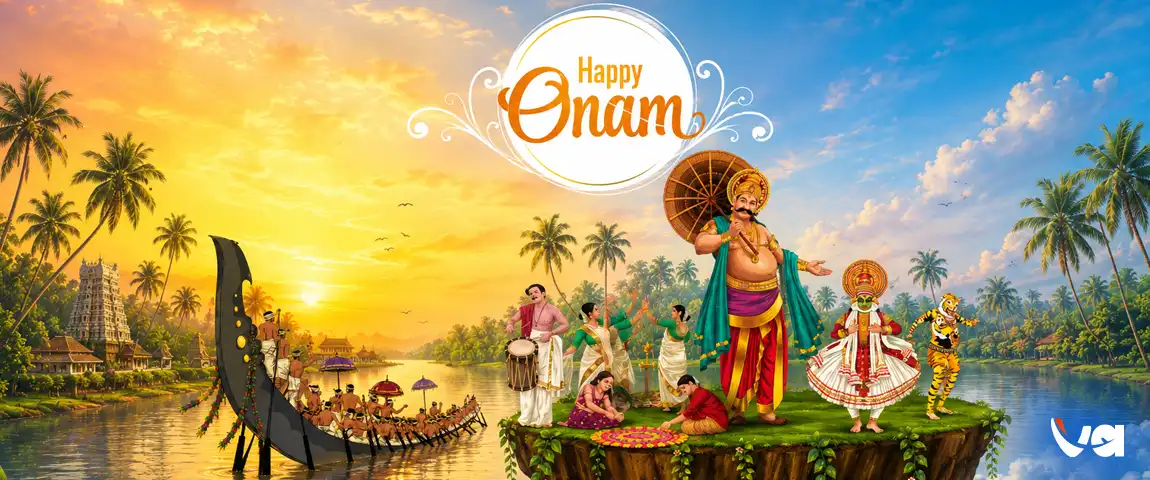
Onam in Kerala 2026: 10-Day Celebrations, Traditions, Food & Events
Posted on Wednesday, August 26th, 2026 by Kamal Kishor Leave a Comment
Onam is Kerala’s grandest festival. It’s not a single-day affair but a 10-day celebration that begins with Atham and peaks on Thiruvonam.
During these days, homes bloom with Pookalam floral carpets. Families gather for the legendary Sadya feast. Streets come alive with cultural performances. And the backwaters turn into racing arenas for Vallam Kali snake boats.
Each day brings something new. Here’s what makes the Onam celebration in Kerala so special.
What are the main traditions of Onam in Kerala?
Onam in Kerala brings together traditions that happen at home, in neighborhoods, and across Kerala’s public celebrations. Here’s a brief look at the customs you’ll see most often:
| Part of the celebration | What happens |
| Onam Pookalam | Families create floral designs outside their homes |
| Onakkodi | People wear new clothes bought for the festival |
| Onam Sadya | A large vegetarian feast is served, usually on a banana leaf |
| Family gatherings | Relatives come together and visit one another |
| Games | Tug-of-war, swings and other traditional games bring people outdoors |
| Vallam Kali | Snake boat races take place on Kerala’s waterways |
| Pulikali | Performers dressed and painted as tigers dance through the streets |
| Cultural programmes | Music, dance and traditional art forms become part of the festivities |
When Is Onam in Kerala?
Onam follows the Malayalam calendar, so dates shift each year. In 2026, Thiruvonam, the main day, falls on August 26. The 10-day celebration begins on August 16 with Atham.
But don’t limit your plans to just August 26. Major events like Pulikali in Thrissur (August 29) and the Aranmula Boat Race (August 30) happen after Thiruvonam too.
Why is Onam celebrated in Kerala, and why does it last for 10 days?
The history of Onam goes back to the legend of King Mahabali – a ruler so beloved that his people still await his return. According to legend, King Mahabali ruled Kerala with remarkable generosity. His kingdom is traditionally described as a place of prosperity, equality, and contentment.
But Mahabali was a daitya, and his growing power made Indra, the King of the Gods, uneasy. Indra and the devas therefore turned to Lord Vishnu for help.
Vishnu came to earth as Vamana, a young dwarf Brahmin. He approached Mahabali during the yagna and made a simple request: three paces of land. Mahabali, bound by his code of generosity, agreed without a second thought.
Vamana began to grow. His first step covered the earth. His second covered the heavens. For the third step, Mahabali bowed his head and offered it to Vamana. Vishnu placed his foot on the king’s head and sent him to Patala, the underworld.
Moved by Mahabali’s devotion, Vishnu granted him a boon: he could return to his people once every year. That homecoming is what Onam celebrates.
| Day | Malayalam name | What happens |
| 1 | Atham | Pookalam begins, festive preparations start |
| 2 | Chithira | Homes are cleaned, and the Pookalam grows |
| 3 | Chodhi | Festive shopping and new clothes become part of preparations |
| 4 | Vishakam | Food and sadya preparations pick up |
| 5 | Anizham | Traditionally associated with the build-up to boat-race festivities |
| 6 | Thriketa | Family visits and preparations continue |
| 7 | Moolam | Community celebrations and cultural activities become more visible |
| 8 | Pooradam | Pookalam and traditional preparations become more elaborate |
| 9 | Uthradam | Final shopping, cooking and home preparations |
| 10 | Thiruvonam | Main celebration, Sadya, Pookalam, family gatherings and festivities |
What happens on each day of Onam?
The 10 days of Onam each have their own traditions and preparations. Here’s what happens as the festival moves from one day to the next.
Day 1 – Atham: The Festival Begins
Atham Onam marks the beginning of the Onam celebrations. Families begin by preparing their homes and laying the first Pookalam. This initial floral carpet, called Athapoo, is small and simple, usually made with yellow flowers. Over the next nine days, it will grow into an elaborate design.
Atham also brings the famous Athachamayam procession to Tripunithura, near Kochi. It’s a spectacular parade with caparisoned elephants, folk performers, and vibrant floats. In 2026, it takes place on August 16.
Day 2 – Chithira: The Pookalam Grows
The Pookalam gets another layer of flowers. Homes are cleaned and decorated, while families continue getting ready for the celebrations ahead. As the days pass, the floral design grows along with the excitement around the festival.
Day 3 – Chodhi: Time for New Clothes
Chodhi is when festive shopping kicks off. Families buy onakkodi, new clothes for the occasion. Women shop for Kasavu sarees with gold borders. Men pick out traditional Mundus. Children get new outfits too.
Day 4 – Vishakam: Sadya Preparations Begin
Vishakam is considered highly auspicious. Families start buying vegetables, coconut, spices, and other ingredients needed for the Onam Sadya. The kitchen now becomes part of the action.
Day 5 – Anizham: The Boats Take Centre Stage
Anizham brings the boats into the picture. This day is associated with Vallam Kali, Kerala’s famous snake boat races. Long, cobra-shaped vessels hit the water. Rowers practice in rhythm. The backwaters begin buzzing with energy. The Onam boat race in Kerala is one of the most anticipated events of the festival.
Day 6 – Thriketa: Family Time Takes Over
By Thriketa, the festival is at its peak. Families visit relatives. Many travel back to their ancestral homes. The Pookalam grows larger. Conversations, laughter, and shared meals become more common.
Day 7 – Moolam: Celebrations Move Outdoors
Moolam brings more activity into neighborhoods and communities. Cultural programs, traditional games, music, and smaller Sadya gatherings become more visible.
Day 8 – Pooradam: The Festive Build-Up
Pooradam is when the king’s presence starts to be felt. In some traditions, clay figures associated with Mahabali and Thrikkakara Appan are placed as part of the Pookalam and household observances.
Day 9 – Uthradam: The Final Preparations
Uthradam is the final preparation day for many families. Shopping is finished, ingredients are brought home, gifts are arranged, and the kitchen gets ready for the next day’s feast.
Did you know? Uthradam is often referred to as First Onam, as families finish their preparations and get ready to welcome Mahabali on Thiruvonam.
Day 10 – Thiruvonam: The Main Celebration
And then comes the day everyone has been preparing for. Families rise early, take a ritual bath, and dress in their Onakkodi. The Pookalam is complete, a vibrant carpet of flowers at the entrance. The kitchen hums with the final touches of the Sadya. Relatives begin arriving.
The day revolves around food, family, and celebration. The Onam Sadya is served on banana leaves. After the feast, traditional games fill the afternoon. Some families visit temples. Others simply enjoy each other’s company. This is the day Mahabali finally returns to his people.
If you’re planning to travel from Delhi, Mumbai, Chennai, or Kolkata, you can easily book your flights to Kerala to join these celebrations.
What does an Onam celebration look like at home?
You don’t need grand public events to experience Onam. For most Malayalis, the real celebration happens at home.
The morning of the Onam family celebration starts with everyone in their new clothes. Someone is finishing the Pookalam outside. The kitchen buzzes with Sadya preparations. Relatives trickle in. Conversations grow louder. Children’s anticipation builds; games come after lunch.
Then comes the Sadya. After the meal, the celebrations continue with games, music, or simply sitting together and talking. There’s no rush. The day is meant to be savored.
It’s easy to forget this home-based side of Onam when you see only the boat races and public events. But it’s the family gatherings that keep the festival personal and meaningful, year after year.
What do people eat during Onam?
Onam Sadya – the meal everyone waits for
If there is one dish, or rather, one entire meal that defines Onam, it is the Sadya. The Onam Sadya is a vegetarian feast served on a banana leaf, with rice at the center and a spread of curries, vegetables, pickles, chips, and sweets arranged around it.
What is served in an Onam Sadya?
A traditional Sadya can have over 20 dishes. The banana leaf is laid with the narrow end to the left. Rice takes the center. Curries, pickles, and sides are arranged around it. Here are some of the classics:
| Dish | What it adds to the Sadya |
| Avial | Mixed vegetables cooked with coconut and a mild seasoning |
| Sambar | Lentil-based vegetable curry |
| Olan | A mild coconut-based preparation usually made with vegetables and coconut milk |
| Thoran | Vegetables cooked with coconut |
| Pachadi | A sweet or tangy side dish |
| Pickles | Sharp, spicy accompaniments |
| Banana chips | Crisp slices served as a snack |
| Papadam | A crunchy accompaniment |
| Payasam | The sweet finish to the meal |
Depending on the setting, a Sadya can range from 9 to over 30 dishes. Every home and region adds its own touch.
Planning to taste an authentic Onam Sadya? Book your Kerala holiday packages and experience it yourself.
The Games You Play During Onam
Onam isn’t just about sitting down for a feast. Traditional games and outdoor activities are an important part of the celebrations, particularly in family and community settings. Here are the most popular Onam games in Kerala.
| Onam game | What happens | What makes it fun |
| Vadam Vali | Teams pull against each other in a tug of war | A noisy, all-in team challenge |
| Uriyadi | Players try to break a hanging pot | A test of timing, balance and nerve |
| Oonjal | People enjoy traditional swings | A relaxed family activity |
| Onathallu | Traditional physical game associated with Onam | Skill, strength and spectacle |
| Archery / local games | Played in some communities and celebrations | Adds local variation |
Onam Events in Kerala: What Can You Actually Watch?
Beyond the family celebrations, Kerala hosts some spectacular public events during Onam. Here are the ones worth planning your trip around:
| Event | Where | What you’ll see | 2026 date | Why go? |
| Athachamayam | Tripunithura | Procession, folk arts, decorated elephants | Aug 16 | See the Onam season open |
| Thiruvonam | Across Kerala | Sadya, Pookalam, family celebrations | Aug 26 | Experience the main day |
| Pulikali | Thrissur | Tiger-painted performers and percussion | Aug 29 | See one of Kerala’s most unusual Onam traditions |
| Aranmula Boat Race | Aranmula | Snake boats and traditional boat culture | Aug 30 | Experience Vallam Kali in a heritage setting |
Traditional Arts You May See During Onam Celebrations In India
During Onam, you’ll also witness these traditional art forms:
| Art form | What you’ll see |
| Thiruvathirakali / Kaikottikali | Group dance traditionally performed by women |
| Kathakali | Elaborate makeup, costume and storytelling |
| Mohiniyattam | Graceful classical dance from Kerala |
| Kummattikali | Masked folk performance |
| Pulikali | Tiger-themed street performance with drums |
Where to Experience Onam in Kerala
There isn’t one single place to experience Onam in Kerala. Tripunithura is ideal for the opening festivities, Thrissur for Pulikali, and Aranmula for the famous boat-race tradition. Choose your destination based on the part of Onam you actually want to experience.
| Place | What to experience | Best for |
| Kochi & Tripunithura | Athachamayam, cultural programmes, local celebrations | Opening of the Onam season |
| Thrissur | Pulikali and public festivities | Folk performances |
| Alappuzha | Backwaters and boat-race events | Vallam Kali experience |
| Aranmula | Aranmula Boat Race and traditional boat culture | Heritage + boat race |
| Thiruvananthapuram | Large cultural programmes and city celebrations | A bigger city-based celebration |
What should you wear for Onam?
Traditional clothing is part of the visual charm of the Onam celebration in Kerala. Here’s what Malayalis traditionally wear during Onam:
| Who | Common festive wear |
| Women | Kasavu sarees and other Kerala-style traditional outfits |
| Men | Mundu with a traditional shirt/kurta |
| Children | Traditional Kerala festive clothing |
Planning to visit Kerala during Onam?
Travanya can help you plan your trip, from comparing domestic flights to exploring Kerala holiday packages. Choose the Onam events you want to experience first, then build your itinerary around them.
- Want the main family celebration? Travel around Thiruvonam.
- Want Athachamayam? Stay around Kochi/Tripunithura on August 16.
- Want Pulikali? Head to Thrissur around August 29.
- Want a boat-race experience? Check the individual Vallam Kali schedule before booking.
Onam is one of Kerala’s busiest travel periods. Flights, trains, buses, and accommodation can see higher demand, so booking early gives you more choice.
Book your flights to Kerala from:
| Departure City | Book Now |
| Delhi → Kochi | Book flights from Delhi to Kochi |
| Mumbai → Kochi | Book flights from Mumbai to Kochi |
| Chennai → Kochi | Book flights from Chennai to Kochi |
| Kolkata → Kochi | Book flights from Kolkata to Kochi |
| Bangalore → Kochi | Book flights from Bangalore to Kochi |
| Hyderabad → Kochi | Book flights from Hyderabad to Kochi |
| Pune → Kochi | Book flights from Pune to Kochi |
| Ahmedabad → Kochi | Book flights from Ahmedabad to Kochi |
Or explore complete Kerala holiday packages:
| Package Type | Explore Now |
| Kerala tour packages | Explore Kerala holiday packages |
| Domestic holiday packages | Browse domestic holiday packages |
FAQs
1. When does Onam start and end in Kerala?
A: Onam 2026, 10 days festival, begins on August 16 (Atham) and ends on August 26 (Thiruvonam).
2. How many days is Onam celebrated in Kerala?
A: Onam is celebrated for 10 days. Its started from 16th August to till 26 August.
3. What is the purpose of celebrating Onam?
A: Onam celebrates the annual return of King Mahabali to Kerala and the harvest season.
4. Which god is associated with Onam?
A: Lord Vishnu, who appeared as Vamana to test King Mahabali.
5. What is the most important day of Onam?
A: Thiruvonam is the main day of the festival.
6. Where can I watch the Onam boat races in Kerala?
A: Alappuzha (Nehru Trophy), Aranmula (Aranmula Boat Race), and other backwater locations.
7. Which places are famous for Onam celebrations in Kerala?
A: Kochi, Thrissur, Alappuzha, Aranmula, and Thiruvananthapuram.
8. What should I eat during Onam in Kerala?
A: The Onam Sadya. It is a vegetarian feast served on a banana leaf.
9. Are Onam celebrations open to tourists?
A: Yes. Tourists are welcome at public events, boat races, and cultural programs.
Final Thoughts
Onam is Kerala at its best. Ten days of color, food, music, and togetherness. A festival that bridges myth and modern life. A celebration of harvest and homecoming.
Whether you’re planning a trip or just curious about the culture, understanding Onam gives you a glimpse into what makes Kerala so special.
The flowers will bloom. The boats will race. The feasts will be shared. And King Mahabali will come home – just like he does every year.
Start planning your Kerala trip with Travanya today.

About Kamal Kishor View All Posts
Kamal is a passionate travel writer who brings destinations to life through his words. With years of experience and a knack for delivering impactful content, he blends creativity with insight in his writing. Growing up in Himachal, he developed a deep love for mountains, treks, and peaceful escapes. With a curious mind and an explorer’s spirit, Kamal aims to inspire readers to discover new places and create unforgettable travel experiences.
Latest Blog
-
10 Different Ways Of Celebrating Dussehra Across Indian States
Oct 1st, 2026 -
Sharad Navratri 2026 Dates, Significance, Celebrations And Travel
Sep 24th, 2026 -
Ganesh Chaturthi 2026: Best Places to Celebrate in India
Sep 17th, 2026 -
25 Best Destinations to Celebrate Christmas Around the World
Oct 14th, 2026 -
Air India Launches Easy Connect Flights From Ahmedabad To 26 Global Destinations
Sep 4th, 2026 -
20 Famous Places to Visit in Kerala in 2026 for a Memorable Holiday
Aug 31st, 2026



Leave a Comment