Akshardham Temple Delhi: A Complete Visitor’s Guide
Posted on Thursday, July 23rd, 2026 by Neha Sharma Leave a Comment
Delhi is a city of monuments. The Red Fort, Qutub Minar, and Humayun’s Tomb attract MILLIONS of visitors every year. But Akshardham Temple offers something different. It is not a relic of the past. It is a modern creation built using ancient techniques, and it draws crowds that rival any historical site in the capital.
Located on the banks of the Yamuna River in east Delhi, the temple complex opened in November 2005. Since then, it has become one of the city’s most visited landmarks, attracting both domestic and international tourists.
The Idea Behind Akshardham Temple
In 1968, Yogiji Maharaj, the spiritual head of the Bochasanwasi Akshar Purushottam Swaminarayan Sanstha (BAPS) organization, first conceived the idea for Akshardham Temple. He desired the construction of a grand temple on the banks of the river Yamuna that would symbolize the glorious cultural heritage of India.
After the death of Yogiji Maharaj, Pramukh Swami Maharaj took on the task of realizing his vision. The process of procuring the land and obtaining the permissions lasted almost two decades. Construction started in November 2000 & ended five years later, in 2005.
It is the level of voluntary involvement of people in this project that deserves attention. More than 7,000 artists and several thousand volunteers were involved in the construction process. They originated from the villages of Gujarat & Rajasthan states & were working on the project as an expression of their devotion without seeking monetary compensation.
Architecture of Akshardham Temple
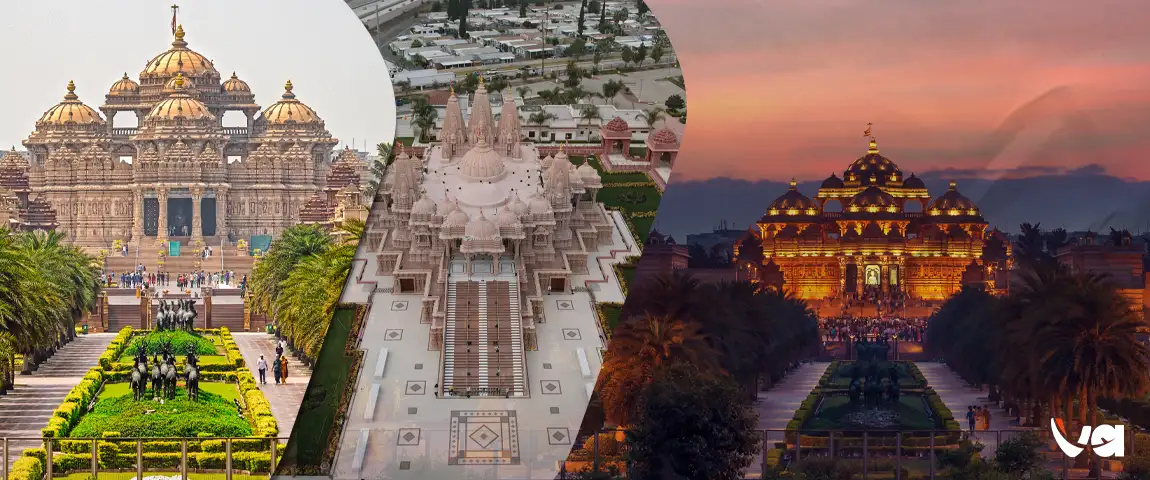
The Akshardham Mandir rises 141 feet high and spreads 316 feet wide. The structure is built entirely from Rajasthani pink sandstone and Italian Carrara marble. No steel or concrete was used in its construction.
This was a deliberate choice. The builders followed the Vastu Shastra & Pancharatra Shastra, ancient texts that guide temple architecture. The void construction of ferrous metals ensures the temple can survive for centuries without the risk of rust or corrosion.
The temple has 234 carved pillars and nine domes. Every surface is covered with intricate carvings depicting mythological scenes, floral patterns, & divine figures. The work is specific. Each pillar is different from the others, & the level of detail demands attention.
At the base of the temple sits the Gajendra Pith, a plinth featuring 148 life-sized stone elephants. Each elephant is carved in a different posture. Together they weigh around 3,000 tonnes. The elephant is a symbol of wisdom and strength in Hindu tradition, and the plinth pays tribute to that symbolism.
Inside the main sanctum, an 11-foot murti of Swaminarayan sits under the central dome. Surrounding him are statues of Sita-Ram, Radha-Krishna, & Shiv-Parvati, along with other deities. These statues are made from paanch daatu, an alloy of five metals, and are crafted using traditional metalworking techniques.
The Exhibitions At Akshardham Temple
The temple complex offers more than a place for worship. It has three main exhibitions that combine technology with storytelling. Techniques are ticketed and separate from the free entry to the main temple.
Sahajanand Darshan
This exhibition uses animatronics, dioramas, and fiber optics to tell stories from Swaminarayan’s life and presents moral lessons on peace, honesty, and compassion. The exhibition includes the world’s smallest animatronic robot, depicting Ghanshyam Maharaj, the child form of Swaminarayan.
Neelkanth Kalyan Yatra
The complex has a theater with an 85-foot by 65-foot screen, one of the largest in Delhi. It screens Neelkanth Yatra, a film about Swaminarayan’s seven-year pilgrimage across India. As a teenage yogi named Neelkanth Varni, he walked 7,000 miles, facing harsh weather and difficult terrain.
Sanskruti Vihar
This is the boat ride, and it is one of the most popular attractions. Visitors board peacock-shaped boats that travel along a water channel. The ride passes dioramas showing 10,000 years of Indian history, including ancient universities, early scientific discoveries, and marketplaces.
The Yagnapurush Kund and Water Show
Outside the main temple lies the Yagnapurush Kund, India’s largest stepwell. It measures 300 feet by 300 feet and contains 2,870 steps and 108 small shrines.
During the day, the stepwell is a quiet spot to sit and rest. In the evening, it becomes the venue for the Sahaj Anand Water Show. The show combines lasers, underwater flames, video projections, and music are used to present a story from the Hindu scripture. The performance lasts 24 minutes and draws large crowds.
The Garden of India
The Bharat Upavan is a landscaped garden that surrounds the main temple. It features bronze sculptures of children, women, freedom fighters, and national figures such as Mahatma Gandhi. The garden celebrates India’s cultural heritage and provides a peaceful space for visitors to walk around.
Practical Information for Visiting Akshardham Temple
- Timings Of Akshardham Temple
The complex opens at 9:30 AM and closes at 8:00 PM. The exhibitions operate from 10:00 AM to 5:00 PM. The temple is closed on Mondays.
- Entry Fees For Akshardham Temple
Entry to the main temple and gardens is free. The exhibition ticket costs ₹170 for adults. Children under four years old can enter free of charge. The musical fountain show costs ₹30 per person.
- How to Reach Akshardham Temple
The Delhi Metro is the easiest way to reach Akshardham. The Akshardham station on the Blue Line is a five-minute walk from the temple entrance. E-rickshaws are available from the station for a small fare. For those driving, parking is available at the site.
- Important Rules For Visiting Akshardham Temple
Electronic items, including cameras and mobile phones, are not allowed inside the complex. A free locker room is available at the entrance for depositing such items. Visitors must dress modestly, with shoulders and knees covered. Outside food is not permitted inside the temple premises.
- How Much Time to Plan Akshardham Temple
A thorough visit takes at least 3 to 4 hours. The exhibitions require time, and the main temple deserves a slow walk. The evening water show adds another hour to the visit.
Conclusion
Akshardham Temple is a place that demands attention. Not because it is loud, but because it is detailed. The carvings, the pillars, the sculptures all of it reflects a level of craftsmanship that is becoming rare in modern construction. The decision to build without steel or concrete was not just about tradition. It was about building something that would last.
The exhibitions feel modern. The animatronics, the giant screen, and the boat ride are attractions designed for a generation raised on theme parks. But they are rooted in stories that are centuries old. That balance between the ancient and the contemporary is what makes Akshardham so special.
FAQs
Q: What is the ticket price for Akshardham Temple?
A: Entry to the main temple and gardens is free. The exhibition ticket costs ₹170 for adults. Children under four get free entry. The musical fountain show costs ₹30.
Q: What is the best way to reach Akshardham Temple?
A: Take the Delhi Metro Blue Line to Akshardham station. The temple is a five-minute walk from the station.
Q: What are the visiting hours and which day is closed?
A: The temple opens from 9:30 AM to 8:00 PM, with exhibitions from 10:00 AM to 5:00 PM. It is closed on Mondays. Q: Is photography allowed inside Akshardham Temple

About Neha Sharma View All Posts
Neha Sharma, a passionate travel blogger, captures the beauty of the world through her words. With her adventurous spirit and a keen eye for detail, Neha takes her readers on mesmerizing journeys to exotic destinations. Her vivid descriptions and insightful tips make her the go-to guide for wanderlust seekers. Join Neha as she explores the globe, sharing her love for travel and inspiring others to go on their unforgettable adventures.
Latest Blog
-
Ganesh Chaturthi 2026: Best Places to Celebrate in India
Sep 17th, 2026 -
25 Best Destinations to Celebrate Christmas Around the World
Sep 14th, 2026 -
Air India Launches Easy Connect Flights From Ahmedabad To 26 Global Destinations
Sep 4th, 2026 -
20 Famous Places to Visit in Kerala in 2026 for a Memorable Holiday
Aug 31st, 2026 -
Onam in Kerala 2026: 10-Day Celebrations, Traditions, Food & Events
Aug 27th, 2026 -
8 Best Shopping Malls Near Delhi Airport for Shopping, Dining, and Entertainment
Aug 14th, 2026



Leave a Comment