
Qatar Airways vs Emirates: Which Airline Really Comes Out on Top?
Posted on Thursday, January 8th, 2026 by shipra Leave a Comment
Selecting the best airline among Qatar Airways vs Emirates is really one of the biggest dilemmas that travellers encounter, particularly for long-haul international flight routes because both the airlines are famous for comfort, global routes, and premium service, which in turn, makes the choice much harder.
Both Qatar Airways and Emirates are incredible carriers with a good name across the globe. Some passengers prefer Qatar Airways for the quieter cabins and steady service, while others opt for Emirates due to the larger planes and more entertainment options. That is why the “Qatar or Emirates, which is better?” debates go on and on.
In this Blog, we will analyze all that there is to know about Qatar Airways and Emirates Airlines in a straightforward way.
Quick Overview: Qatar Airways vs Emirates
Before comparing both airlines in detail, it is a good idea to have a quick overview of both airlines. This part is for those travelers who need quick and clear information based on facts prior to deciding on selecting between Qatar Airways and Emirates.
| Feature | Qatar Airways | Emirates |
| Founded | 1993 | 1985 |
| Home Hub | Hamad International Airport (Doha) | Dubai International Airport (DXB) |
| Alliance | Oneworld | Not part of any alliance |
| Fleet Type | Mixed wide-body fleet | All wide-body fleet |
| Popular Aircraft | Airbus A320, Boeing 787 | Airbus A380, Boeing 777 |
| Destinations | 170+ worldwide | 150+ worldwide |
| Known For | Service quality, business class | Entertainment, spacious cabins |
Route Network & Global Connectivity (Qatar Airways vs Emirates)

In terms of worldwide presence, the two airlines are powerful, however, they have dissimilar operating methods. The comparison of Qatar Airways with Emirates in the areas of destinations, connections, and transit experience is made easier through this section.
| Factor | Qatar Airways | Emirates |
| Global Destinations | 170+ | 150+ |
| Main Transit Hub | Doha | Dubai |
| Transit Experience | Faster, more compact airport | Larger airport with more facilities |
| Long-Haul Focus | Strong | Very strong |
Qatar Airways Route Network
Qatar Airways operates through its hub at Doha’s Hamad International Airport, which mainly accommodates international transfers for its operations. The air carrier connects more than 170 places worldwide and includes most of the important cities in Asia, Europe, Africa, the United States, and Australia. Qatar has become recognized for its quick connections that require only one stopover, particularly between India, Europe, and North America. A lot of travelers consider that the waiting period in Doha is shorter and more systematic, thus contributing to the total experience.
Emirates Route Network
Emirates operates from Dubai International Airport, one of the busiest global hubs. With flights to 150+ destinations, Emirates focuses heavily on long-haul routes using large aircraft. Dubai acts as a central stopover point for passengers travelling between Asia, Europe, Africa, Australia, and the US. Emirates is often preferred by travellers who want more flight frequency and flexible timing options, especially on popular international routes.
Aircraft & Fleet Comparison (Qatar Airways vs Emirates)
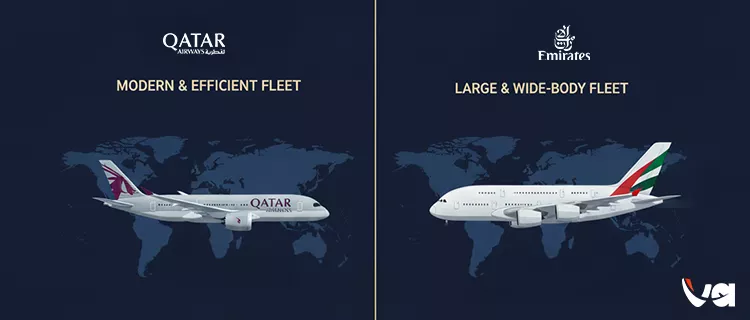
The type of aircraft an airline uses plays a big role in comfort, cabin space, and the overall flying experience. When comparing Qatar Airways vs Emirates, both airlines rely mainly on modern wide-body aircraft, but their fleet strategy is quite different.
| Factor | Qatar Airways | Emirates |
| Fleet Type | Mixed wide-body | All wide-body |
| Newer Aircraft Usage | Very frequent | Moderate |
| Most Used Aircraft | A350, B787 | A380, B777 |
| Cabin Noise Level | Lower | Moderate |
| Focus | Efficiency & comfort | Space & capacity |
Qatar Airways Fleet
Qatar Airways has a mixed wide-body fleet that comprises different types of aircraft and hence can serve not only international long-haul but also medium-haul routes quite easily. The company has established a strong reputation for introducing new aircraft types before their competitors, even if they come later.
The Airbus A320 and Boeing 787 Dreamliner are two of the most popular models, mainly for long-distance travel. Their silent cabins, excellent air quality, and more efficient engines are great advantages for the airlines but direct benefits to the passengers as well. The airlines’ noise level and comfort have thus been well associated with Qatar’s soft and quiet experience in the sky.
Emirates Fleet
Emirates uses a more selective approach with an entire wide-body fleet, which indicates that every airplane is made for long-distance flights. The company mostly flies the Airbus A380 and Boeing 777, which are both recognized for their roomy cabins and high seating capacity. Furthermore, Emirates ranks among the top A380 carriers globally, thereby enhancing its position with regard to physical space, lounges, and entertainment alternatives. This selection of fleet is perfect for passengers who appreciate more space and a cabin with more features.
Cabin Classes Comparison (Qatar Airways vs Emirates)
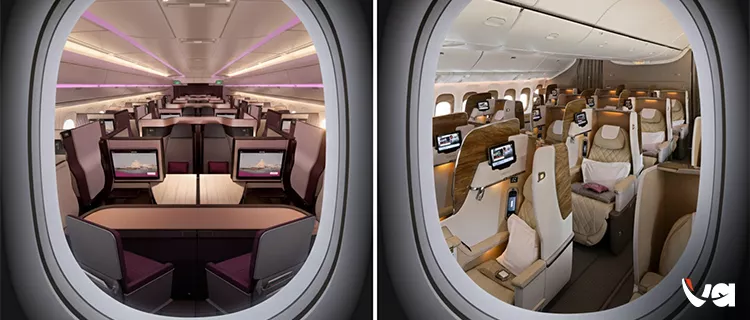
Airline cabin experience is such a major point that it can help you to a clear choice between Qatar Airways and Emirates if you are going for a long international flight. However, both airlines provide four major classes of fare, yet the arrangement, the comfort, and the overall mood on board can vary.
Economy Class: Qatar Airways vs Emirates
| Factor | Qatar Airways Economy | Emirates Economy |
| Seat Pitch | Around 31–33 inches | Around 31–34 inches |
| Cabin Feel | Calm and quiet | Spacious and lively |
| Meals | Region-based, good variety | Multi-cuisine, generous portions |
| Entertainment | Personal screen, wide content | Larger screens, very extensive content |
In the economy class, both airlines concentrate on comfort to withstand long hours of flying. Very often, Qatar Airways is associated with somewhat calmer cabins and unchanging comfort of seats while, on the contrary, Emirates is praised for the maximum width of the cabins of the bigger planes, particularly that of the A380.
Business Class: Qatar vs Emirates
| Factor | Qatar Airways Business | Emirates Business |
| Seat Type | Fully flat, Qsuite on many routes | Fully flat (A380 best experience) |
| Privacy | Very high | Moderate to high |
| Lounge Access | Premium lounges worldwide | Large lounges, especially in Dubai |
| Overall Experience | Sleek and private | Comfortable and social |
Qatar Airways’ business class is often praised for its Qsuite, while an Emirates business class ticket stands out on certain aircraft due to onboard amenities.
First Class: Qatar Airways vs Emirates
| Factor | Qatar Airways First | Emirates First |
| Suites | Fully enclosed | Fully enclosed |
| Shower Spa | No | Yes (A380) |
| Onboard Lounge | No | Yes |
| Overall Feel | Quiet and refined | Feature-rich and premium |
Both airlines offer luxury, but the approach is different. Qatar focuses on privacy, while Emirates focuses on features.
In-Flight Experience (Qatar Airways vs Emirates)

The in-flight experience is very important for most travellers when choosing the airline for their long-haul flights, thus making the competition between Qatar Airways vs Emirates a draw. Here’s a transparent and simple division that illustrates the situation according to the typical passengers’ preferences.
Seat Comfort & Cabin Feel
- Qatar Airways: Quieter cabins, softer lighting, and a more relaxed atmosphere. Works well for overnight and long flights.
- Emirates: Bigger aircraft mean wider cabins, higher ceilings, and a more open feel, especially on the A380.
Food & Beverage
- Qatar Airways: Route-based meals with consistent quality across classes. Simple presentation and balanced flavours.
- Emirates: Larger portions, more menu choices, and strong beverage service on long flights.
Entertainment & Wi-Fi
- Qatar Airways: Oryx One system with good movie and TV options. Functional and easy to use.
- Emirates: ICE system with a huge content library, bigger screens, and free Wi-Fi for Skywards members.
Overall Experience
- Choose Qatar Airways if you prefer a calm, quiet, and smooth journey.
- Choose Emirates if you enjoy space, features, and strong entertainment throughout the flight.
Baggage Allowance (Qatar Airways vs Emirates)

Baggage rules can directly affect your travel experience, especially on international flights. Here’s a clear and easy comparison of Qatar Airways vs Emirates, so you know exactly what to expect.
Checked Baggage (Main Luggage)
| Cabin Class | Qatar Airways | Emirates |
| Economy Class | 25–35 kg (depends on ticket type) | 25–35 kg (depends on ticket type) |
| Business Class | Up to 32 kg | Up to 32 kg |
| First Class | Up to 50 kg | Up to 50 kg |
👉 In simple words: baggage allowance is almost the same on both airlines.
Cabin / Hand Baggage
This is what you can carry inside the aircraft.
| Cabin Class | Qatar Airways | Emirates |
| Economy | 1 bag up to 7 kg | 1 bag up to 7 kg |
| Business / First | Up to 15 kg total | Up to 14 kg total |
Extra Baggage
- Qatar Airways: You can buy extra baggage online before the flight, which is usually cheaper.
- Emirates: Also allows advance purchase of extra baggage, based on weight or extra pieces.
Financial Stability (Qatar Airways vs Emirates)

Financial strength matters because it shows how stable an airline is and how well it can invest in better aircraft, services, and routes. Here’s a short and easy comparison based on the latest official results.
Qatar Airways (Financial Snapshot)
- Reported its highest-ever profit in the 2024–25 financial year.
- According to online sources, it earned around US$2+ billion in net profit, showing strong recovery and growth.
- Carried 40+ million passengers, with steady demand on long-haul routes.
- Continues to invest in new aircraft and premium services, especially Business Class.
In simple terms, Qatar Airways is financially strong, profitable, and growing at a steady pace.
Emirates (Financial Snapshot)
- Became the world’s most profitable airline in 2024–25.
- According to online sources, It Recorded around US$6+ billion in profit, the highest in its history.
- Generated nearly US$40 billion in total revenue.
- Carried 50+ million passengers, backed by Dubai’s high global traffic.
In simple terms, Emirates is extremely financially strong and operates on a much larger global scale.
What does this mean for you?
- Qatar Airways offers stability with focused growth and consistent service quality.
- Emirates leads in financial power, size, and long-term global dominance.
Book Flights at the Best Price with Travanya!

Still confused about Qatar vs Emirates, or want the best flight deal on your chosen airline? Let Travanya’s travel experts help you with:
- Best available fares on Qatar Airways & Emirates
- Route suggestions with shorter layovers
- Extra baggage deals & flexible ticket options
- 24/7 booking assistance
📞 Call Travanya now: +91-869-999-5345
Get quick support, honest advice, and flight deals that actually make sense for your journey.
FAQs
1. Does Shimla have an airport?
A: Yes, Shimla has its own airport called Jubbarhatti Airport. It is located around 22 km from the city and is the closest airport to Shimla. However, flight connectivity is limited, so it’s best to check availability in advance.
2. What is the nearest airport to Manali?
A: The nearest airport to Manali is Bhuntar Airport (KUU), situated about 50 km away. It is also known as the closest airport to Manali and offers scenic road connectivity to the hill station.
3. Which is the closest airport to Dharamshala?
A: Kangra Airport (DHM) is the closest airport to Dharamshala, located just 12 km away. It is one of the most convenient hill stations in Himachal Pradesh to reach by air.
4. What is the nearest airport to Mussoorie?
A: The closest airport to Mussoorie is Jolly Grant Airport, Dehradun, approximately 60 km away. From here, taxis and buses are easily available for a comfortable road journey.
5. What is the nearest airport to Gulmarg?
A: Srinagar Airport (SXR) is the nearest airport to Gulmarg, located around 56 km away. The drive from Srinagar to Gulmarg is scenic and usually takes 2 to 3 hours.
6. Which airport is closest to Leh Ladakh?
A: The nearest airport to Leh Ladakh is Kushok Bakula Rimpochee Airport (IXL). It is just 4 km from the city, making Leh one of the easiest high-altitude hill destinations to reach by flight.
7. What is the nearest airport in Meghalaya?
A: Shillong Airport (SHL) is the nearest airport in Meghalaya, located about 30 km from the city. It offers smooth road connectivity and is ideal for travellers heading to Shillong and nearby areas.
8. Are there hill stations in India with airport access?
A: Yes, there are several hill stations in India with airport access, including Shimla, Manali, Dharamshala, Leh, Gulmarg, Ooty, and Shillong. These airports help reduce travel time and make hill vacations more convenient.

About shipra View All Posts
Latest Blog
-
Things to Buy in Thailand – Smart Shopping Guide for Every Indian Traveler
Feb 13th, 2026 -
Airports in Thailand for Travelers: Top Airport Names & Easy Travel Guide!
Jan 29th, 2026 -
Top Beaches in Thailand – Complete Beach Travel Guide!
Feb 9th, 2026 -
Best Places to Visit on Valentine’s Day in India This February!
Jan 30th, 2026 -
How to Earn Airline Loyalty Points Fast in 2026? Smart Ways to Get Free Flights!
Jan 22nd, 2026 -
15 Best Tourist Places in Himachal Pradesh for Everyone!
Feb 9th, 2026



Leave a Comment